Beverage, Dairy & Sauce
Dairy Processing Line
Dairies, cooperatives and investors starting or expanding fresh milk, yogurt or long-life milk production.
Sized to raw milk received per day and finished product filled per hour

07 · Beverage, Dairy & Sauce — Equipment
Heats product to a set temperature, holds it for a set time and cools it, in plate, tubular, batch or in-pack form, to run your validated process.
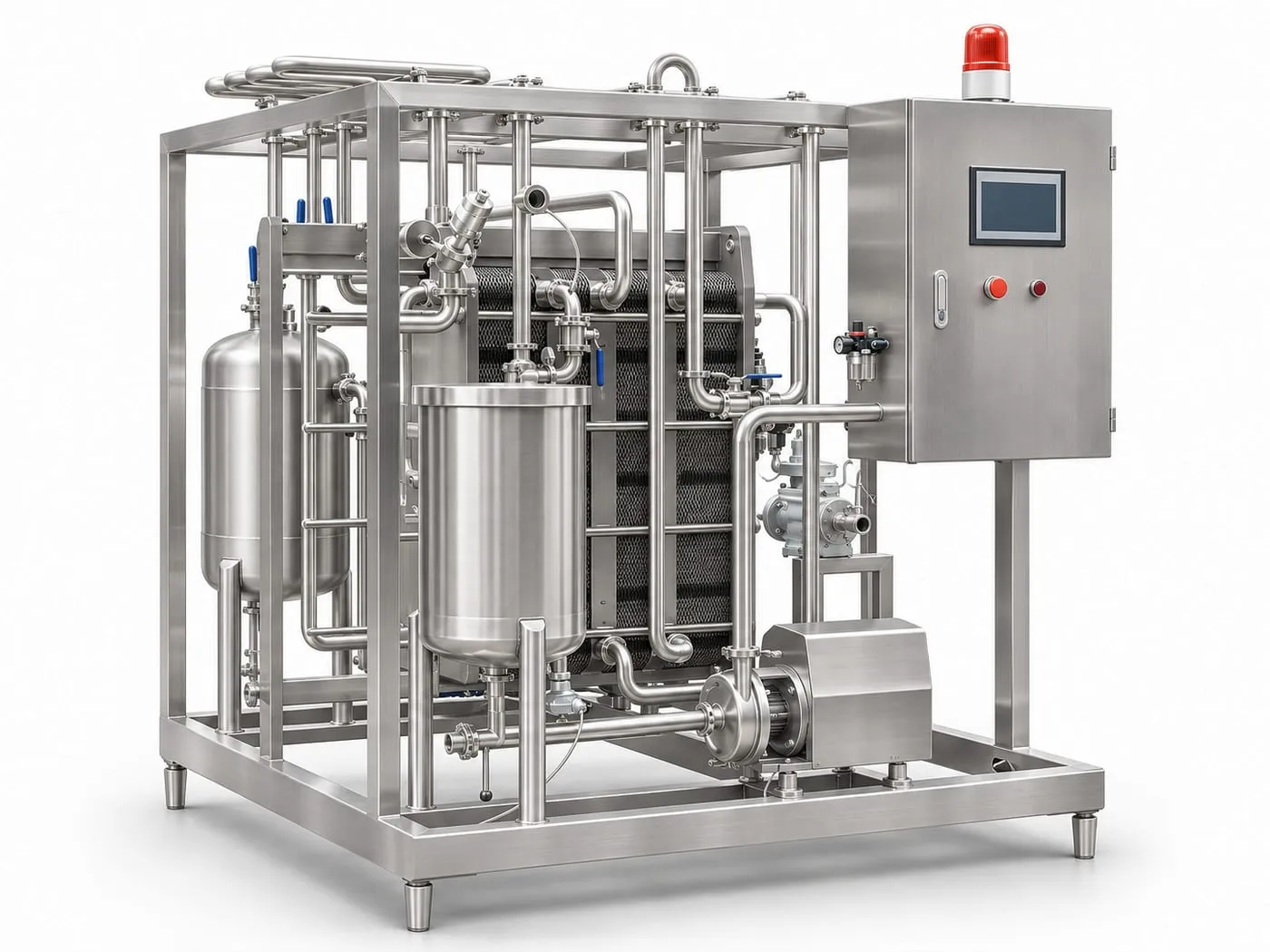
Short answer: A pasteurizer heats a liquid or packed food to a set temperature, holds it there for a set time and then cools it, to run a heat process that has been validated for your product. The choice of plate, tubular, batch or in-pack design depends mainly on the product itself: viscosity, pulp and particles, and whether you treat before or after filling.
On a continuous unit, product is pumped from a balance tank into a heat exchanger. A regeneration section first warms incoming cold product with hot outgoing product, saving energy. A heating section raises it to the set temperature with hot water or steam, and a holding tube keeps it there for the required time. A temperature sensor at the end of the holding tube controls a diversion valve: if the product is below temperature, it goes back to the balance tank instead of forward. The product is then cooled and sent to a buffer tank or filler.
Batch tank units heat and hold the product in a jacketed tank with an agitator. In-pack units carry filled, sealed containers through hot water or spray zones, then cooling zones.
| Form | Suits | Watch out for |
|---|---|---|
| Plate | Milk, clear juices, thin liquids | Fouling or blockage with pulp |
| Tubular | Pulpy juices, purees, thicker products | Larger footprint than plates |
| Batch tank | Small volumes, many recipes | Longer heating and cooling time |
| In-pack water bath | Bottled or jarred drinks and sauces | Pack must tolerate heat |
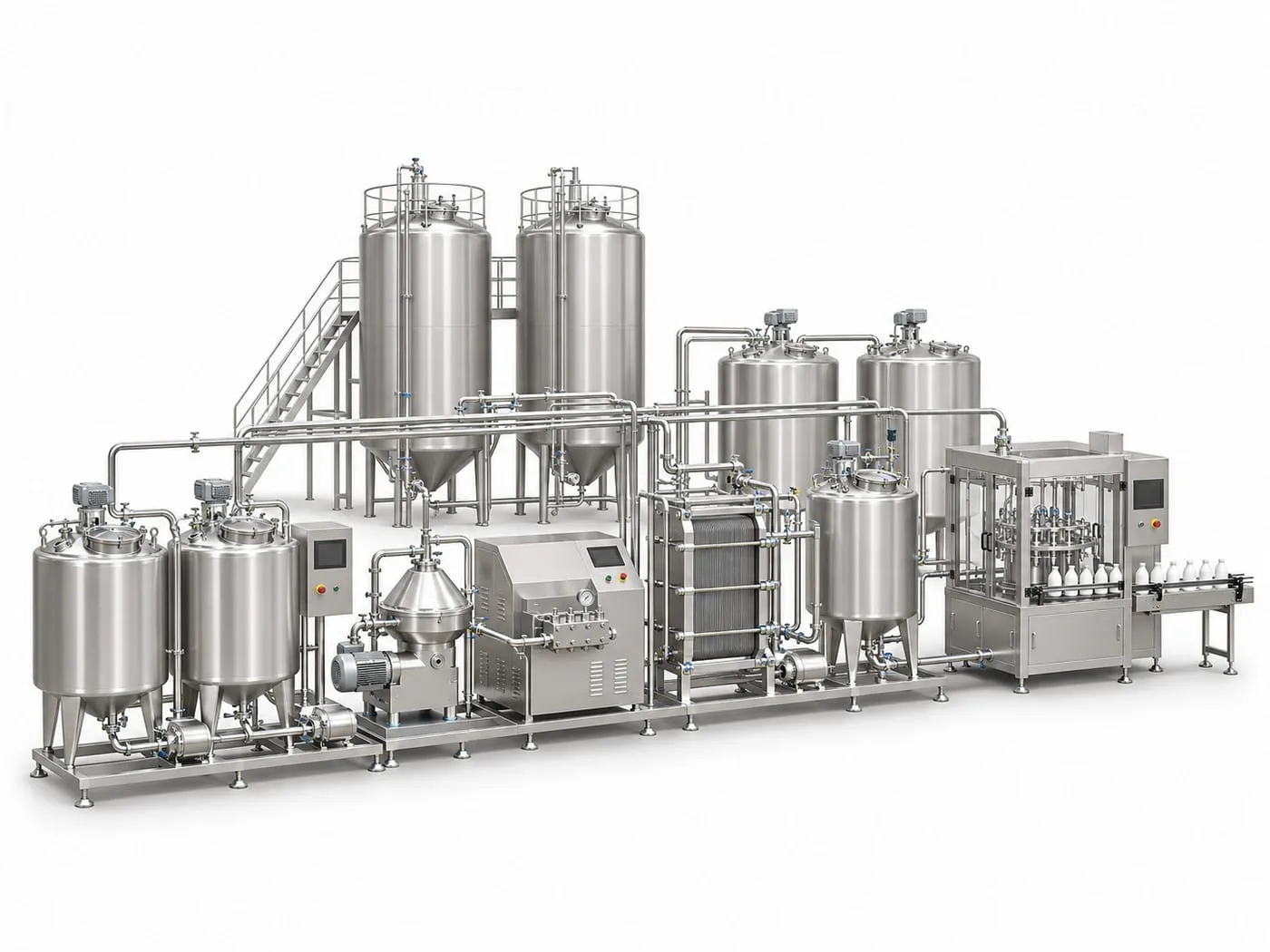
The pasteurizer usually follows a food homogenizer and feeds a liquid filling machine. It is the core of a dairy processing line or juice processing line, with a food steam generator for heat and a CIP cleaning system for cleaning.
Plate pasteurizer
compact with efficient heat recovery, suited to milk, clear juices and low-viscosity liquids without particles.
Tubular pasteurizer
wider flow channels for pulpy juices, purees and more viscous products that would block plates.
Batch tank pasteurizer
heats, holds and cools in a jacketed tank, for small volumes and many recipes.
In-pack water bath
heats sealed bottles, jars or pouches in hot water or spray after filling.
Our engineers check these points with you, so the quotation fits your site rather than a catalogue default.
The process must meet regulations in your market and be validated for your product, usually with help from a food technologist or process authority. We build the pasteurizer to deliver and record the conditions you specify.
Plates suit thin liquids without particles and use space and energy efficiently. Products with pulp, fibres or higher viscosity foul or block plates, so a tubular design is the safer choice.
If a plate leaks, pasteurised product should never be contaminated by raw product or cooling water. Keeping the treated side at a higher pressure than the raw or service side is a standard safeguard, and we design the pumps and controls around it.
Tell us your raw material, finished product and target output. Our engineers reply with a matched configuration and quotation.
What to send with your inquiry
Email sales@hnfoda.com
How food machinery distribution works: what dealers get from a factory, what factories expect, territory, spare parts, service and how to start.
Plan a small milk plant: cooling, pasteurising, homogenising and filling equipment, sizing litres per day, cost drivers and a quote checklist.
Beverage, Dairy & Sauce
Dairies, cooperatives and investors starting or expanding fresh milk, yogurt or long-life milk production.
Sized to raw milk received per day and finished product filled per hour
Beverage, Dairy & Sauce
Fruit processors, beverage start-ups and contract packers making juices, nectars or blended drinks.
Sized to finished beverage filled per hour, with fruit input calculated from your yield
Beverage, Dairy & Sauce
Food companies, brand owners and contract packers producing chilli, tomato or compound seasoning sauces.
Sized to finished sauce filled per hour or per batch (kg)
Beverage, Dairy & Sauce
Soy food workshops scaling up, plant-based drink brands and tofu factories supplying retail or food service.
Sized to dry soybean input (kg/h) and the finished product it turns into