Beverage, Dairy & Sauce
Dairy Processing Line
Dairies, cooperatives and investors starting or expanding fresh milk, yogurt or long-life milk production.
Sized to raw milk received per day and finished product filled per hour

07 · Beverage, Dairy & Sauce — Equipment
Breaks down fat droplets and particles so dairy products, drinks and sauces stay smooth and do not separate on the shelf.
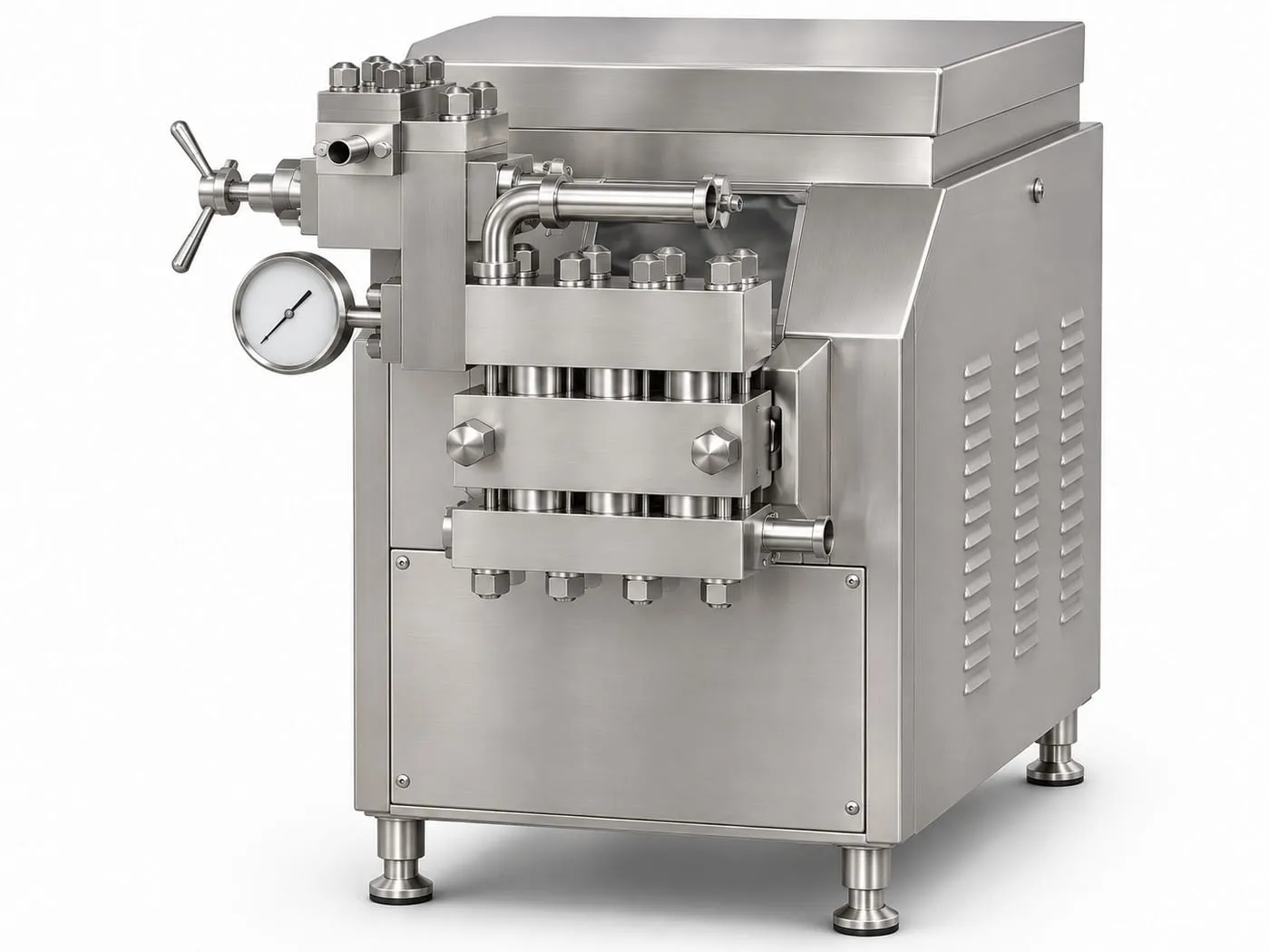
Short answer: A food homogenizer breaks fat droplets and fine particles into smaller, even sizes so milk, drinks and sauces stay smooth and do not separate. The right type depends on the product: its viscosity, particles and fibres, the flow you need and how much temperature rise the product can take.
A high-pressure homogenizer uses a piston pump to raise product to high pressure and force it through a narrow gap in a homogenising valve. The sudden drop in pressure, turbulence and impact break fat droplets apart. Many machines have two stages: the first does most of the size reduction, and the second breaks up clusters that form after it.
An in-line high-shear emulsifier has a fast rotor turning inside a slotted stator. Product is drawn in, sheared in the narrow gap and pushed out through the slots. It is effective for mixing oil and water phases, dispersing powders and thickeners, and smoothing sauces, but does not reach the droplet sizes of a high-pressure machine.
In a line, the homogenizer usually works on warm product, often between preheating and final heat treatment.
| Form | Suits | Watch out for |
|---|---|---|
| High-pressure homogenizer | Milk, cream, plant-based drinks, cloudy juices | Particles and fibres can damage valves |
| In-line high-shear emulsifier | Sauces, dressings, powder dispersion | Coarser emulsions than high pressure |
Some plants use both: a high-shear mixer to disperse powders and oil in a mixing tank, then a high-pressure homogenizer in line for the final droplet size. A short trial with your product is the most reliable way to choose.
In a dairy processing line or juice processing line, the homogenizer sits before or within the pasteurizer. In sauce and nut butter production it can follow a colloid mill, and it is cleaned with the line by a CIP cleaning system.
High-pressure homogenizer
a piston pump forces product through a narrow valve, giving very fine droplets for milk, cream and plant-based drinks.
In-line high-shear emulsifier
a rotor and stator mix and emulsify at lower pressure, suited to sauces, dressings and products with powders to disperse.
Our engineers check these points with you, so the quotation fits your site rather than a catalogue default.
For milk, cream and plant-based drinks that must stay stable for weeks, a high-pressure homogenizer is usually required. For sauces, dressings and dispersing powders, an in-line high-shear emulsifier is often enough and costs less to run.
Within limits. Large pulp or fibres can damage valves or block the unit. Tell us the pulp content and size, and we check whether to screen the product first or choose a different machine.
Pressure and shear turn into heat, so product temperature rises through the machine. How much depends on pressure, product and design; we size cooling or position the homogenizer in the line so the rise stays within your limit.
Tell us your raw material, finished product and target output. Our engineers reply with a matched configuration and quotation.
What to send with your inquiry
Email sales@hnfoda.com
Plan a small milk plant: cooling, pasteurising, homogenising and filling equipment, sizing litres per day, cost drivers and a quote checklist.
Beverage, Dairy & Sauce
Dairies, cooperatives and investors starting or expanding fresh milk, yogurt or long-life milk production.
Sized to raw milk received per day and finished product filled per hour
Beverage, Dairy & Sauce
Fruit processors, beverage start-ups and contract packers making juices, nectars or blended drinks.
Sized to finished beverage filled per hour, with fruit input calculated from your yield
Beverage, Dairy & Sauce
Food companies, brand owners and contract packers producing chilli, tomato or compound seasoning sauces.
Sized to finished sauce filled per hour or per batch (kg)
Beverage, Dairy & Sauce
Soy food workshops scaling up, plant-based drink brands and tofu factories supplying retail or food service.
Sized to dry soybean input (kg/h) and the finished product it turns into