Beverage, Dairy & Sauce
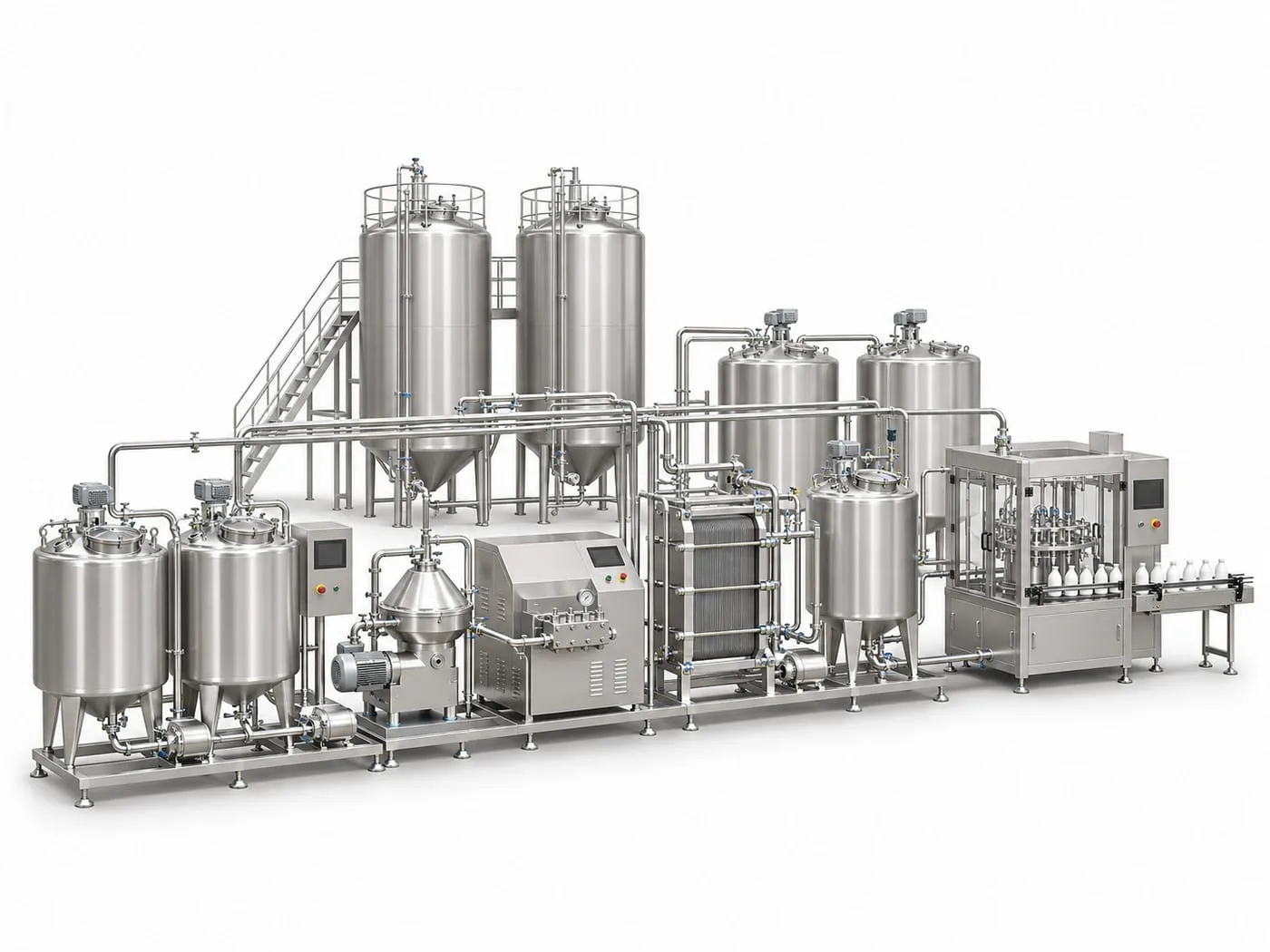
Dairy Processing Line
Dairies, cooperatives and investors starting or expanding fresh milk, yogurt or long-life milk production.
Sized to raw milk received per day and finished product filled per hour

07 · Beverage, Dairy & Sauce — Equipment
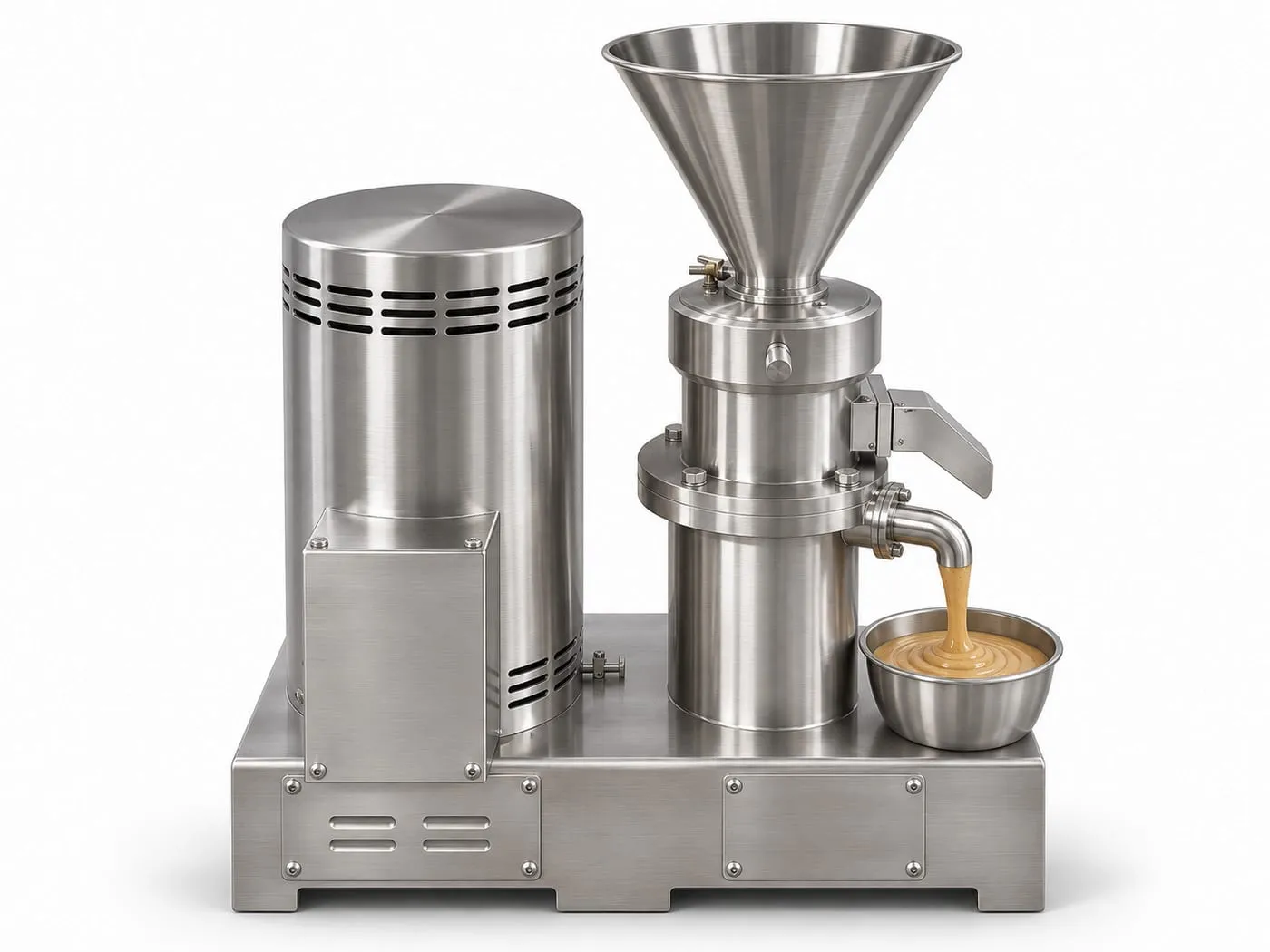
Grinds wet products finely between a fast rotor and a fixed stator, for nut butters, sesame paste, sauces and other pastes.
Short answer: A colloid mill grinds wet products very finely by passing them through a narrow, adjustable gap between a fast-turning rotor and a fixed stator. Its configuration depends on solids content and viscosity, the particle size going in, the fineness you need and how much heat your product can take.
Product enters the hopper and is drawn into the gap between the rotor and stator. Both have toothed or grooved conical surfaces. As the rotor turns at high speed, the product is sheared, crushed and rubbed between the surfaces, reducing particle size and mixing the ingredients. The gap is set with an adjusting ring: a narrower gap gives a finer result but lowers output and raises temperature.
A cooling jacket around the grinding chamber can carry chilled water to limit temperature rise. On recirculating set-ups, a return pipe sends product back to the hopper so it passes through the gap several times until it reaches the target texture.
| Form | Suits | Watch out for |
|---|---|---|
| Vertical | Thick pastes, nut butter, sesame paste | Needs steady gravity feed |
| Horizontal | Pumpable sauces and liquids in a pipe line | Thick pastes may need a feed pump |
| Recirculating | Very fine textures in several passes | Longer processing time and heat build-up |
For nut butters and sesame paste, the vertical mill is the usual choice. For sauces that already flow and are pumped through the plant, a horizontal mill fits more easily into the pipework.
In a nut butter production line, the colloid mill follows the nut roaster and peeling. In a sauce processing line, it sits between ingredient preparation and the jacketed cooking kettle. Smooth pastes then go to a liquid filling machine or a food homogenizer where a finer emulsion is needed.
Vertical colloid mill
hopper on top, gravity feed; common for thick pastes such as nut butters and sesame paste.
Horizontal colloid mill
inline design that is easier to feed by pump and fit into a pipe line, for more fluid products.
Recirculating mill
product returns to the hopper or a tank for several passes until it reaches the target fineness.
Our engineers check these points with you, so the quotation fits your site rather than a catalogue default.
It depends on the product, inlet particle size, gap setting and number of passes. We do not quote a fineness figure without knowing the recipe; a sample trial is the reliable way to check.
Often yes. Whole nuts, seeds or large pieces should be broken down first, because large particles at the inlet reduce output and wear the rotor and stator faster.
Fine grinding turns energy into heat, which can darken nut butters or release oil. Use a mill with a cooling jacket, feed product at a steady rate, and consider two passes with a cooling step rather than one very tight pass.
Tell us your raw material, finished product and target output. Our engineers reply with a matched configuration and quotation.
What to send with your inquiry
Email sales@hnfoda.com
Plan a peanut butter business: equipment by stage, how to size capacity on nut input, aflatoxin control, cost drivers and a quotation checklist.
Beverage, Dairy & Sauce
Dairies, cooperatives and investors starting or expanding fresh milk, yogurt or long-life milk production.
Sized to raw milk received per day and finished product filled per hour
Beverage, Dairy & Sauce
Fruit processors, beverage start-ups and contract packers making juices, nectars or blended drinks.
Sized to finished beverage filled per hour, with fruit input calculated from your yield
Beverage, Dairy & Sauce
Food companies, brand owners and contract packers producing chilli, tomato or compound seasoning sauces.
Sized to finished sauce filled per hour or per batch (kg)
Beverage, Dairy & Sauce
Soy food workshops scaling up, plant-based drink brands and tofu factories supplying retail or food service.
Sized to dry soybean input (kg/h) and the finished product it turns into