Beverage, Dairy & Sauce
Juice and Beverage Processing Line
Fruit processors, beverage start-ups and contract packers making juices, nectars or blended drinks.
Sized to finished beverage filled per hour, with fruit input calculated from your yield

07 · Beverage, Dairy & Sauce — Production line
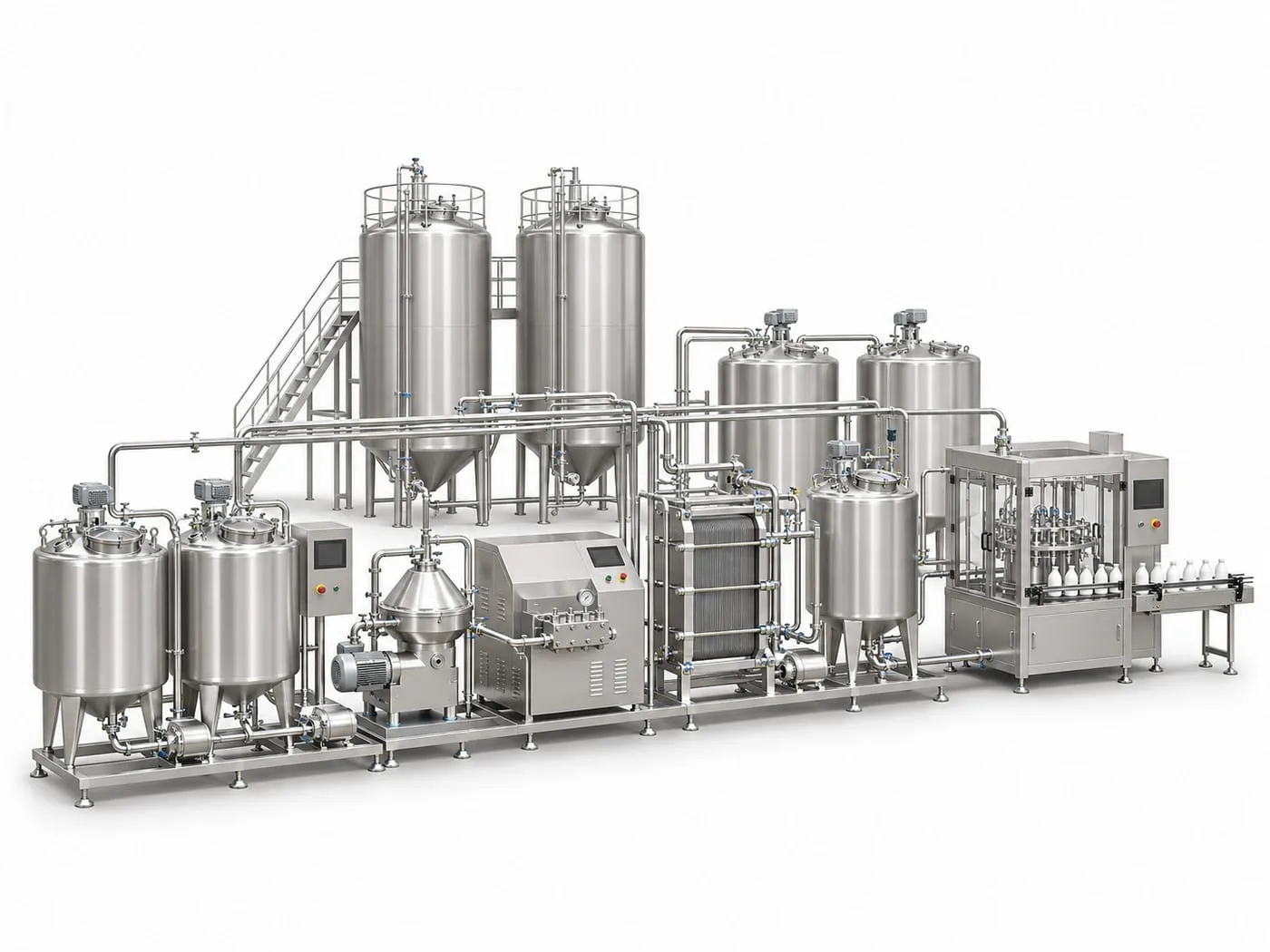
Links milk reception, storage, standardisation, homogenising, heat treatment and filling into one line built around your products and route to market.
Short answer: A dairy processing line takes raw milk from reception through storage, standardising, homogenising and heat treatment to filling. Its design depends first on your products and whether they are sold chilled through a cold chain or as long-life milk stored at room temperature.
A typical line has these stations:
| Form | Suits | Watch out for |
|---|---|---|
| Pasteurised milk | Local markets with a cold chain | Short shelf life, daily distribution |
| Yogurt fermentation | Added-value products from the same milk | Starter culture handling and incubation control |
| Long-life (aseptic) | Wider distribution without refrigeration | Aseptic filling, higher skills and validation |
Many dairies start with pasteurised milk and yogurt, then add other routes when distribution allows.
Capacity is best planned on raw milk received per day, because collection volumes change with the season. Tanks and the reception area are usually sized for the peak month, while processing equipment runs longer hours when supply is high.
The line combines a food homogenizer, a pasteurizer and a CIP cleaning system, with a food steam generator supplying heat. Filling is handled by a liquid filling machine or a premade pouch packing machine, depending on the pack.
Pasteurised milk line
reception, cooling, standardising, homogenising, pasteurising and cold filling, for chilled milk sold through a cold chain.
Yogurt fermentation line
adds heat treatment for yogurt milk, fermentation tanks or incubation rooms, cooling and filling for set or stirred yogurt.
Long-life milk line
higher heat treatment and aseptic filling for milk that is stored and shipped without refrigeration.
Our engineers check these points with you, so the quotation fits your site rather than a catalogue default.
It depends on your market. Fresh milk and yogurt need a cold chain from the plant to the shelf but cost less to set up. Long-life milk can travel further without refrigeration but needs aseptic equipment, tighter controls and more trained staff.
Daily milk volume, the number of products, the heat treatment route, the filling and packaging format, the level of automation and how much of the cleaning system is automatic. Building and utilities such as steam, chilled water and compressed air also need budgeting.
Time and temperature must meet the regulations in your market and be validated for your product. We design the equipment to deliver and record the process you specify, and help you plan the validation.
Tell us your raw material, finished product and target output. Our engineers reply with a matched configuration and quotation.
What to send with your inquiry
Email sales@hnfoda.com
Plan a small milk plant: cooling, pasteurising, homogenising and filling equipment, sizing litres per day, cost drivers and a quote checklist.
Beverage, Dairy & Sauce
Fruit processors, beverage start-ups and contract packers making juices, nectars or blended drinks.
Sized to finished beverage filled per hour, with fruit input calculated from your yield
Beverage, Dairy & Sauce
Food companies, brand owners and contract packers producing chilli, tomato or compound seasoning sauces.
Sized to finished sauce filled per hour or per batch (kg)
Beverage, Dairy & Sauce
Soy food workshops scaling up, plant-based drink brands and tofu factories supplying retail or food service.
Sized to dry soybean input (kg/h) and the finished product it turns into
Beverage, Dairy & Sauce
Dairies, juice and beverage plants and sauce makers that need controlled, recorded heat treatment.
Sized to product flow (L/h) for continuous units, or batch volume for tank and in-pack units