Fruit & Vegetable Processing
Blanching and Cooling Line
Frozen vegetable, dehydrated vegetable and canning plants that need controlled heat treatment before the next step.
Sized to product input (kg/h) at your residence time and piece thickness

01 · Fruit & Vegetable Processing — Equipment
Removes surface water left on produce after washing or blanching, reducing the load on dryers and freezers and keeping packs dry.
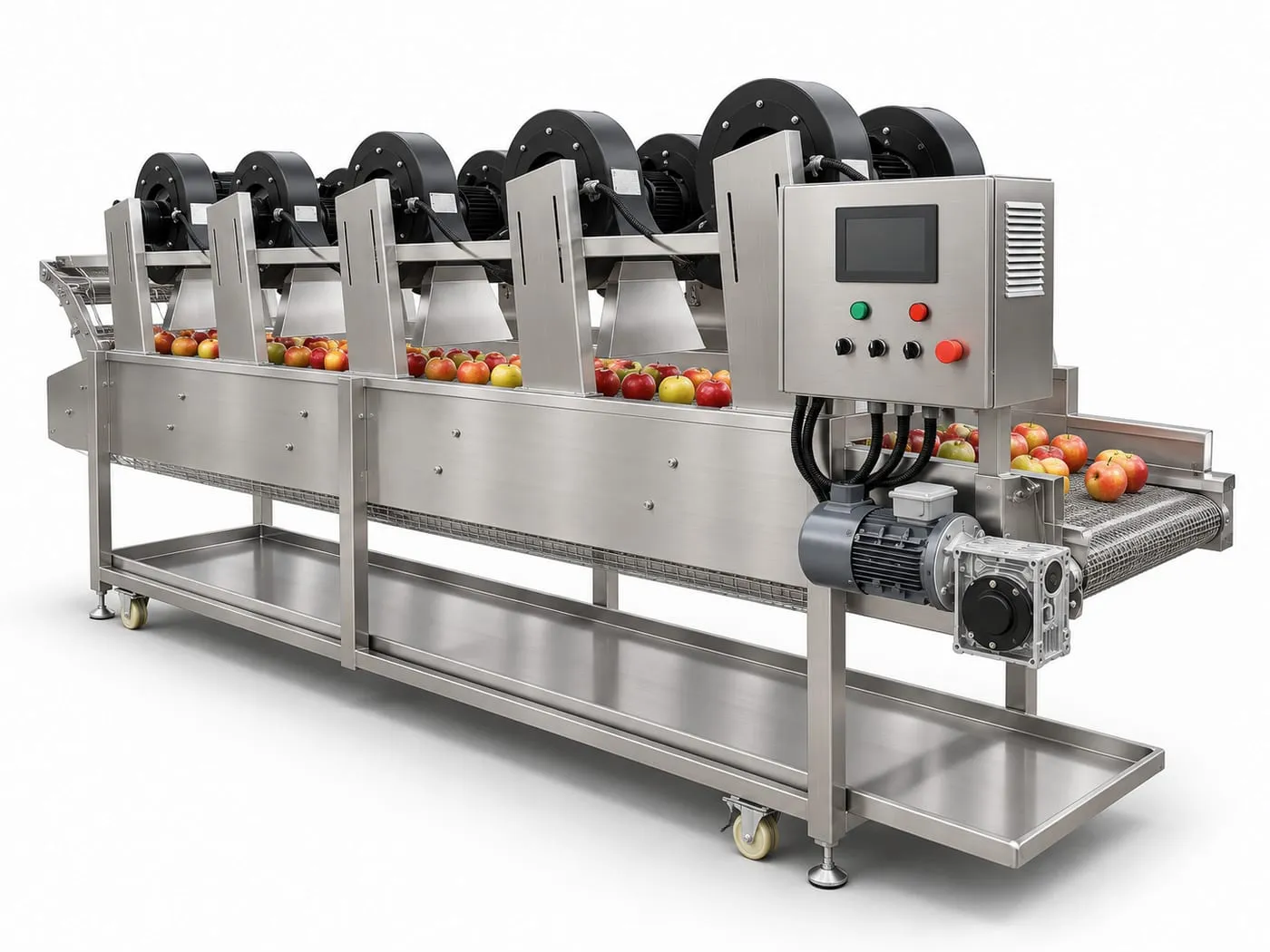
Short answer: An air knife dewatering machine blows surface water off produce after washing or blanching, so less water reaches the dryer, freezer or pack. The key choices are how dry the surface must be and whether the product can lie in a single layer without being blown away.
Wet produce is spread onto a mesh belt by a vibrating feeder. As it travels, rows of narrow nozzles fed by high-pressure fans blow sheets of air across it from above and, on most designs, from below through the belt. The air strips water droplets from the surface; the water drips into a tray and drains away. Several rows in series, sometimes with a short tumbling transfer between them, help expose all sides of each piece.
In a tumbling air dryer, product rolls inside a rotating drum or over a series of rollers while air blows across it. In a centrifugal dewaterer, a batch of product in a perforated basket is spun so that water is thrown outward, which removes water quickly from leafy and cut product but is less gentle.
The machine removes surface water only; it does not dry the product inside. If you need a lower moisture content, the dewaterer is a preparation step for a dryer, not a replacement for one.
| Form | Suits | Watch out for |
|---|---|---|
| Mesh belt air knife | Whole fruit, root vegetables, firm cut pieces | Light pieces may lift; belt must not be overloaded |
| Tumbling air dryer | Cherry tomatoes, berries, small round items | Gentle handling must be checked for soft fruit |
| Centrifugal dewaterer | Salad leaves, shredded and cut vegetables | Batch operation; can bruise delicate items |
The dewaterer sits after a fruit and vegetable washer or the cooling end of a blanching and cooling line. It feeds a food freezer, a hot-air dryer, a fruit and vegetable sorter or a packing machine.
Mesh belt air knife
product passes in a single layer under high-velocity air; suits whole fruit and firm pieces.
Tumbling air dryer
product turns while air blows over it, so all sides are exposed; suits small round items.
Centrifugal dewaterer
spins a basket to throw off water; fast for leafy and cut produce that tolerates spinning.
Our engineers check these points with you, so the quotation fits your site rather than a catalogue default.
Surface water becomes ice that makes pieces stick together in a freezer, and in a dryer it is extra water to evaporate. Removing it first saves energy and improves free-flowing product.
They can. For leaves or small cut pieces we adjust air speed and nozzle angle, add covers, or recommend a centrifugal dewaterer instead. Send samples or photos so we can judge.
High-pressure fans are noticeable. Noise depends on fan type, number of fans and enclosure; tell us your limit and we can include silencing covers or place fans away from operators.
Tell us your raw material, finished product and target output. Our engineers reply with a matched configuration and quotation.
What to send with your inquiry
Email sales@hnfoda.com
Fruit & Vegetable Processing
Frozen vegetable, dehydrated vegetable and canning plants that need controlled heat treatment before the next step.
Sized to product input (kg/h) at your residence time and piece thickness
Fruit & Vegetable Processing
Plants producing fruit puree, tomato paste base, jam, baby food, nectar or sauce bases.
Sized to raw fruit input (kg/h); pulp output depends on fruit and screen size
Fruit & Vegetable Processing
Plants washing fresh produce before peeling, cutting, blanching, drying or packing.
Sized to raw produce input (kg/h), not finished product
Fruit & Vegetable Processing
Potato, carrot, cassava, ginger and taro processors who wash and peel before cutting.
Sized to raw root crop input (kg/h or kg per batch)