Skip to content

02 · Dried Fruit & Nut Processing — Equipment

Rotary Coating Drum

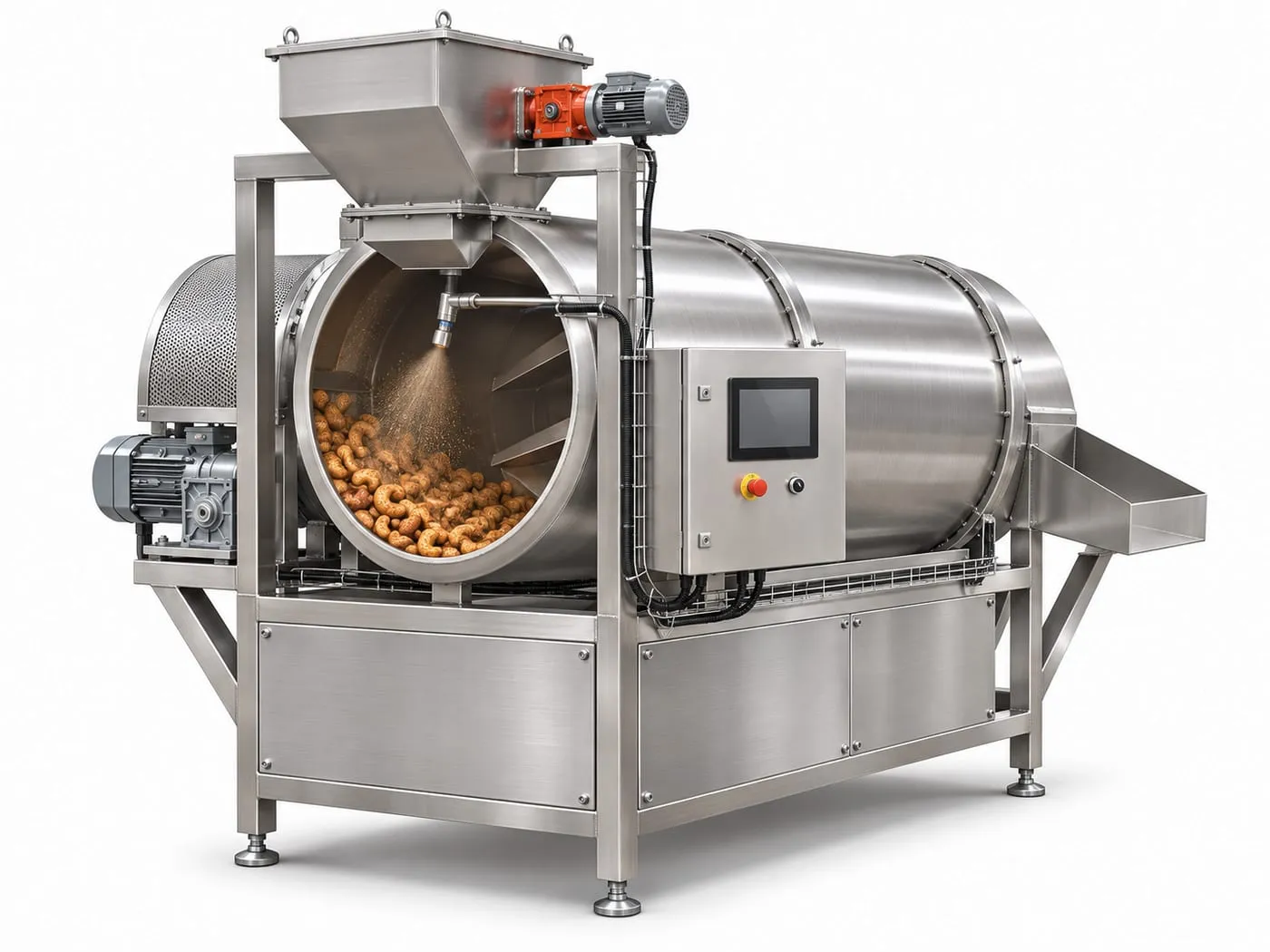
Tumbles nuts or snack pieces while powder, syrup or seasoning liquid is added, building an even coating. Pan, continuous drum and spray-dust designs.

Rating
Sized to base product input (kg per batch or kg/h) and the coating weight added
Versions
Tilted coating pan · Continuous drum · Spray and dusting combination
Best for
Nut and snack producers making coated peanuts, sugar-coated nuts, seasoned snacks and layered products
  • Layered coatings built up in controlled steps
  • Batch pan or continuous drum depending on volume
  • Heating or air blowing options to set syrup coatings
  • Open designs to make cleaning between recipes easier

Short answer: A rotary coating drum tumbles nuts or snack pieces while powder, syrup or seasoning liquid is added, so the coating builds up evenly on every piece. Coating thickness, the stickiness of the liquid and how quickly you need to switch between recipes decide whether a pan, a continuous drum or a spray-and-dust combination suits you.

How it works

In a tilted coating pan, the base product rolls inside a bowl turning at an angle. An operator or dosing system adds a layer of syrup or liquid; once the pieces are wet, powder is dusted in, and the tumbling rolls it into an even layer. The cycle repeats until the coating reaches the target thickness. Warm air or heating of the pan helps syrup coatings set.

A continuous drum is a long cylinder set at a slight incline. Product enters at one end, is sprayed with liquid and dusted with powder in successive zones, and leaves at the other end. Drum speed and incline set how long pieces stay inside. Flights or baffles help mix without breaking pieces.

In both designs the balance between liquid and powder decides the result. Too much liquid at once makes pieces stick together in clumps; too little leaves loose powder in the drum. Dosing in small, repeated steps is slower but gives a more even coat, which is why layered products take longer than a simple seasoning.

Which configuration fits

Form Suits Watch out for
Tilted coating pan Many recipes, small batches, sugar-coated nuts Operator skill decides consistency
Continuous drum Seasoned snacks and nuts, long runs Less flexible for frequent recipe change
Spray and dusting combination Flour-coated peanuts, multi-layer coatings More dosing equipment to clean and calibrate

What we need from you to quote

  • Base product and its size range
  • Coating recipe: powders, syrups, liquids and their viscosity
  • Target coating weight and appearance, ideally with samples
  • Throughput measured on base product input
  • Number of recipes, changeover frequency and cleaning method
  • Process after coating: roasting, frying, drying or cooling

Where it sits in a line

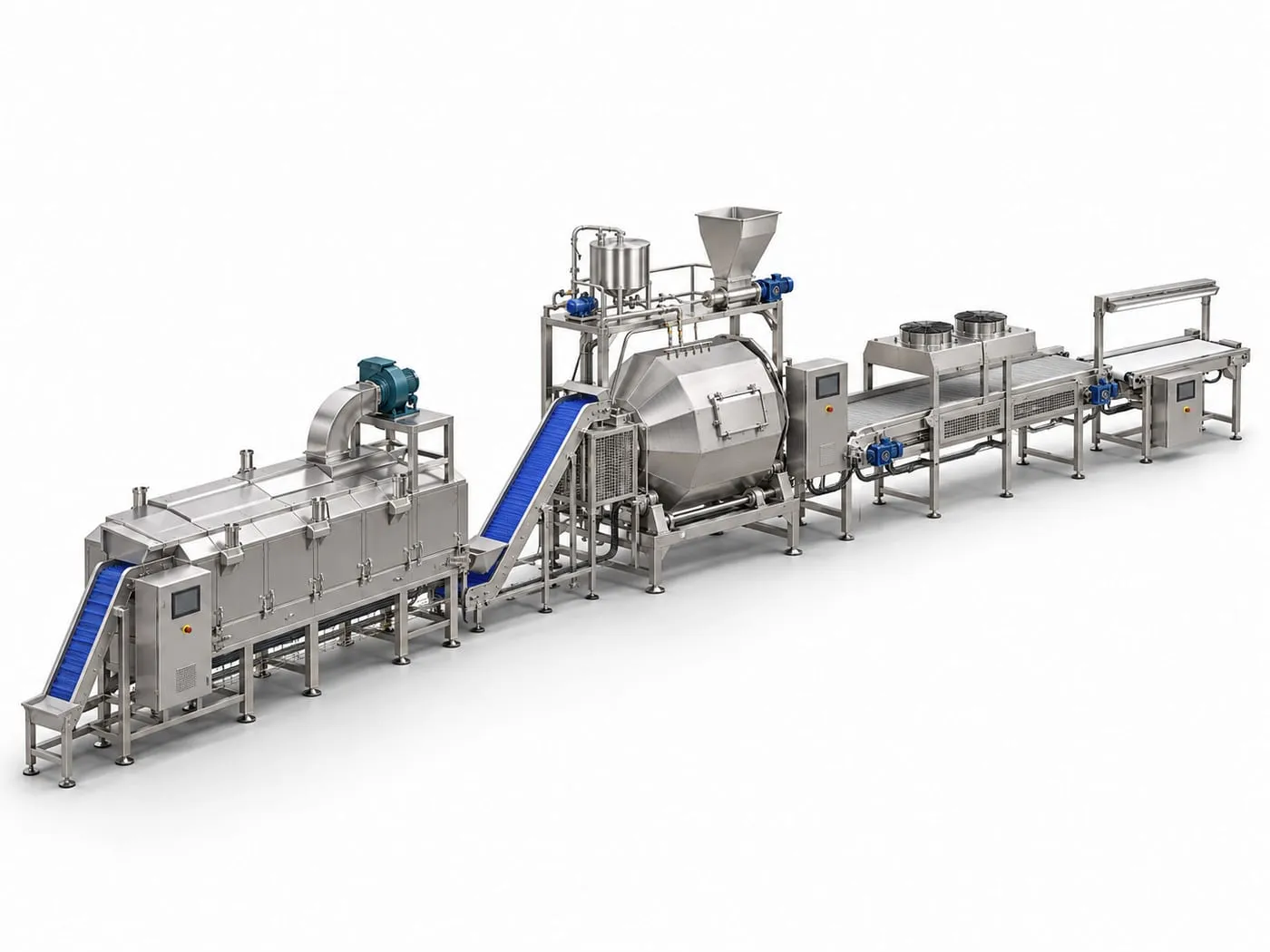
Coating follows a nut roaster or nut skin peeling machine, or sits ahead of a continuous fryer for fried coated nuts. In automated plants it forms part of a nut seasoning line. Coated products are cooled and passed to a multihead weigher for packing.

Common configurations

  1. Option A

    Tilted coating pan

    a bowl-shaped pan rotates at an angle; operators build coating in layers, flexible for many recipes.

  2. Option B

    Continuous drum

    product passes through a long rotating drum with dosing; suits long runs of one product.

  3. Option C

    Spray and dusting combination

    liquid sprayed and powder dosed in alternating zones for thicker or multi-layer coatings.

What we confirm before quoting

Our engineers check these points with you, so the quotation fits your site rather than a catalogue default.

  1. 01Coating thickness or coating weight per kg of base product
  2. 02Viscosity of syrups or liquids used
  3. 03How evenly the coating must cover each piece
  4. 04Cleaning time and method between products
  5. 05Drying or frying needed after coating

Frequently asked questions

  1. Pan or continuous drum?

    Pans are inexpensive, flexible and suit small batches and many recipes, but need an operator. Continuous drums give steady quality for long runs and fit into automated lines.

  2. How do I get a thicker coating?

    Build it in several layers, alternating liquid and powder, and let each layer set. Adding too much at once makes pieces stick together. Syrup viscosity and temperature also matter.

  3. What happens after coating?

    Coated nuts are often roasted, baked or fried to set the coating, then cooled and packed. Flour-coated peanuts, for example, usually go to a roaster or fryer after the drum.

Get a quote for the Rotary Coating Drum

Tell us your raw material, finished product and target output. Our engineers reply with a matched configuration and quotation.

What to send with your inquiry

  1. 1Raw material and its condition
  2. 2Finished product and packaging
  3. 3Target output — raw input or finished product
  4. 4Site photos, power supply, utilities

Email sales@hnfoda.com

Send your inquiry

Your details are used only to answer your inquiry — see our Privacy Policy.

Buyer guides

  • Dried Fruit & Nut Processing

    Dried Fruit Processing Line

    Investors and food companies starting or expanding dried fruit, fruit chip or dried fruit snack production.

    Sized to fresh fruit input (kg/h or tonnes per day); dried output depends on moisture removed

  • Dried Fruit & Nut Processing

    Date Processing Line

    Date packers and processors adding value with washed, pitted or paste products for retail and industry.

    Sized to whole date input (kg/h or tonnes per day)

  • Dried Fruit & Nut Processing

    Nut Butter Production Line

    Food companies and brand owners launching peanut butter, almond butter or nut spread products.

    Sized to roasted nut input (kg/h); output is close to input for pure nut butter

  • Dried Fruit & Nut Processing

    Nut Seasoning Line

    Snack nut producers making salted, spiced, honey-roasted or coated nuts.

    Sized to roasted nut input (kg/h) plus the seasoning added

WhatsAppRequest a quote